Owning a home is likely the biggest financial commitment of your life. Yet, a surprising number of UK homeowners treat home insurance as a “tick-box” exercise, auto-renewing with the same provider year after year. This apathy is costing British households millions.
The landscape for Home Insurance in the UK has shifted dramatically in late 2025. After a period of steep inflation, premiums are finally stabilizing and, in some cases, falling. Industry forecasts for 2026 suggest a “buyer’s market” is emerging, driven by intense competition between legacy insurers like Aviva and agile digital challengers.
This guide effectively cuts through the jargon. We will explain exactly what you need, who the top-rated providers are right now, and how to secure comprehensive protection for your property without overpaying.
The “Shake Test”: Do You Need Buildings, Contents, or Both?
Before comparing quotes, you must understand exactly what you are buying. The industry uses a simple analogy known as the “Shake Test.”
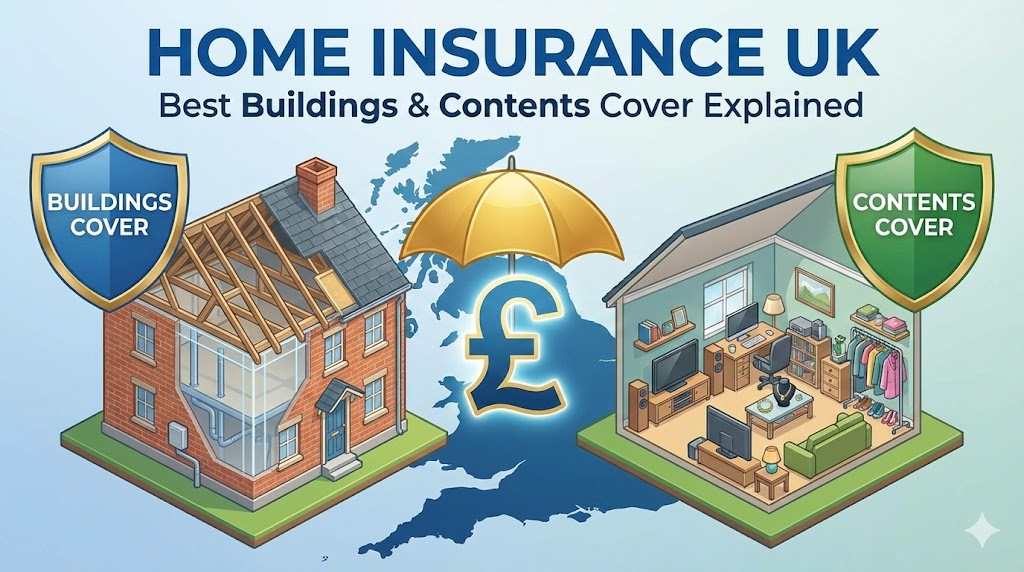
1. Buildings Insurance
Imagine you could pick your house up, turn it upside down, and shake it. Everything that does not fall out is covered by Buildings Insurance.
- What it covers: The structure (walls, roof, floors), bathroom suites, fitted kitchens, and permanent fixtures like built-in wardrobes.
- Who needs it: Freeholders and mortgage holders. (Note: If you have a mortgage, this is mandatory).
- 2026 Outlook: Rebuild costs have stabilized, meaning premiums for buildings-only cover are leveling off at around £200 – £220 per year.
2. Contents Insurance
Now imagine shaking the house again. Everything that falls out is covered by Contents Insurance.
- What it covers: Furniture, carpets, curtains, electronics, clothes, and jewelry.
- Who needs it: Everyone—including renters.
- Key Insight: Many renters mistakenly believe their landlord’s insurance covers their laptop or TV. It does not.
3. Combined Cover
- The Strategy: Buying both from the same provider is almost always cheaper than buying separate policies.
- Average Cost: A combined policy in the UK currently averages £251 per year, offering a significant discount compared to buying separately.
Top Rated Home Insurance Providers (2025/2026)
Based on Defaqto ratings, claims payout ratios, and customer service scores, these are the standout performers in the UK market right now.
1. Halifax (Defaqto Home Insurer of the Year 2025)
- The Verdict: The current market leader for comprehensive protection.
- Why It Wins: Halifax has been aggressive in offering high-quality cover that includes “Home Emergency” and “Burst Pipes” as standard—features often sold as expensive add-ons by others.
- Best For: Homeowners who want “set it and forget it” peace of mind.
2. Aviva (Best for Claims)
- The Verdict: A heavyweight with deep pockets.
- Why It Wins: Their “Signature” policy is famous for the Unlimited Rebuild Guarantee. Most policies ask you to estimate the rebuild cost of your home (e.g., £250,000). If you guess wrong and your home is destroyed, you are underinsured. Aviva removes this risk by promising to pay “whatever it takes” to rebuild.
- Best For: High-value homes or older properties where rebuild costs are hard to estimate.
3. LV= (Liverpool Victoria)
- The Verdict: The “fairness” champion.
- Why It Wins: LV= offers a “Home Plus” policy that includes up to £100,000 in alternative accommodation. If your home is flooded and you need to rent a house for 12 months while it dries out, this high limit is a financial lifesaver.
- Best For: Families who need robust backup plans.
4. Urban Jungle (Best for Renters)
- The Verdict: The disruptor.
- Why It Wins: Designed purely for “Generation Rent.” It uses AI to offer fast, monthly rolling contracts that are easy to cancel.
- Best For: Tenants and young professionals.
The Hidden Factors Driving Your Price
Why does your neighbour pay £150 while you pay £350? Insurers use complex risk algorithms. Here are the “High CPC” factors that swing the needle.
1. The “Bedroom Rate” vs. “Sum Insured”
Old policies asked you to calculate the exact value of your contents (e.g., £34,500). If you missed a diamond ring, you were in trouble.
- The New Standard: Modern “Bedroom Rated” policies simply ask how many bedrooms you have and give you a blanket cover (e.g., £50,000 contents cover for a 2-bed). This is safer for you and reduces the risk of being underinsured.
2. Subsidence Risk
With the hot, dry summers of 2024 and 2025, subsidence (ground shrinking beneath your home) has become a major claim trigger.
- The Warning: If you live in a clay soil area (common in the South East), your premiums may be 20-30% higher. Never hide this history; if you fail to declare past subsidence, your policy is void.
3. Unoccupied Periods
Most standard policies stop covering you if your home is left empty for more than 30 days (e.g., a long holiday or gap between tenants).
- The Fix: If you travel often, look for “60-day” policies from providers like Saga (for over 50s) or specialist brokers.
5 Proven Ways to Slash Your Premium
You do not need to cut coverage to cut costs. Use these structural changes to lower your risk profile.
1. The “25-Day” Rule
Data from MoneySuperMarket shows a bizarre sweet spot. Buying your policy 25 days before your renewal date can save you an average of £5.35 to £10, but more importantly, it signals to the insurer that you are “organized” and “low risk.” Buying on the day of renewal signals panic, often resulting in a higher algorithm-generated price.
2. Increase Your Excess
The “voluntary excess” is the first amount you pay towards a claim.
- The Math: Increasing your excess from £100 to £500 can reduce your annual premium by 10-15%.
- The Logic: You should only claim for catastrophic events (fire, flood, burglary). For a £200 broken window, it is often better to pay out of pocket to protect your No Claims Discount. Therefore, a high excess makes financial sense.
3. Install “Smart” Security
A standard burglar alarm is good, but a connected smart water leak detector is better.
- Why: “Escape of Water” (leaking pipes) is the single biggest cause of claims in the UK—costing insurers more than burglary. Proving you have a leak detector (like LeakBot) can trigger discounts with tech-savvy insurers like Hiscox or Neos.
4. Avoid Monthly Interest
Home insurers are notorious for high APRs on monthly payments (often 20%+).
- The Saving: Always pay annually. If you can’t afford the lump sum, use a 0% purchase credit card to pay it, then pay off the card monthly. This beats the insurer’s interest rate.
5. Buy “Accidental Damage” Wisely
Accidental damage (e.g., spilling red wine on the carpet or putting a foot through the ceiling) is usually an extra.
- The Tip: If you have young children or pets, it is essential. If you live alone and are careful, you can strip this out to save £30-£50 a year.
Regional Price Watch (2025/2026)
Where you live dictates your base rate. Here is the current “heat map” of costs:
- London: The most expensive region (~£333/year) due to high theft rates and high property values.
- North East: The cheapest region (~£158/year).
- Flood Risk Areas: If you are in a flood zone, ensure your insurer is part of the Flood Re scheme. This government-backed initiative caps the cost of the “flood risk” part of your premium, ensuring you aren’t priced out of the market.
Conclusion: Don’t Auto-Renew
The “loyalty penalty” has theoretically been banned by the FCA, meaning insurers can’t charge existing customers more than new ones. However, this has just meant that new customer prices have risen to match.
The only way to truly save is to move to a provider that favors your specific risk profile (e.g., moving from a generic insurer to a specialist over-50s insurer if you are older).