If you run a business in the UK, one simple mistake in your insurance paperwork could cost you £2,500 a day in government fines. That is not a scare tactic; it is the current legal penalty for failing to hold valid Employers’ Liability (EL) insurance when you are required to.
Yet, in 2026, the confusion between Public Liability (PL) and Employers’ Liability remains the single biggest source of wasted money for British SMEs. Many sole traders buy employer cover they don’t need, while growing limited companies inadvertently leave themselves exposed to bankruptcy-level lawsuits because they misunderstood the definition of an “employee.”
With commercial insurance premiums stabilizing in early 2026 after years of inflation, now is the perfect moment to audit your coverage. This guide will strip away the broker jargon, explain the critical differences between these two policies, and show you how to get comprehensive protection for the lowest possible price.
The “Big Two” Explained: What Are You Actually Buying?
To get the best deal, you first need to stop viewing “business insurance” as a single product. It is a bundle of risks. The two most common components are distinct, and confusing them is dangerous.
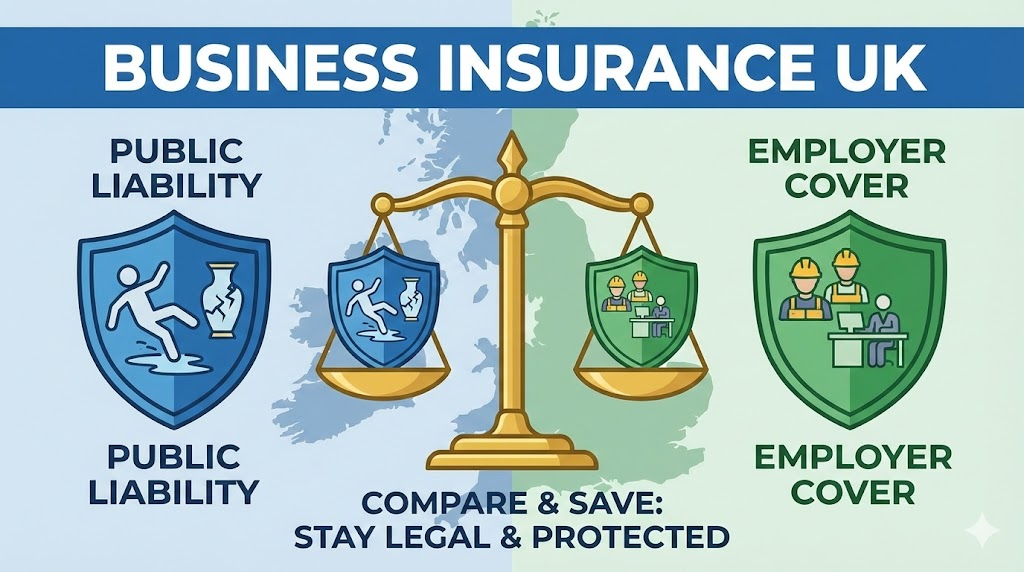
1. Public Liability Insurance (PL)
- The “Whoops” Cover: This protects you if someone else (a client, a customer, or a passerby) gets hurt or their property is damaged because of your business.
- Is it Legal Mandatory? No (with very few exceptions like horse riding establishments).
- Is it “Real World” Mandatory? Yes. You cannot trade effectively without it. Local authorities, trade associations, and corporate clients will refuse to sign contracts with you unless you can prove you have at least £2 million (and increasingly £5 million) in PL cover.
- Example Claim: You are a plumber. You drop a wrench and crack a client’s expensive tiled floor. PL pays for the floor. Without it, you pay £3,000 out of your own pocket.
2. Employers’ Liability Insurance (EL)
- The “Staff” Cover: This protects you if your staff get ill or injured as a result of working for you.
- Is it Legal Mandatory? YES. If you employ even one person, the Employers’ Liability (Compulsory Insurance) Act 1969 requires you to have at least £5 million of cover.
- The Fine: The Health and Safety Executive (HSE) can fine you £2,500 for every single day you are uninsured. You can also be fined £1,000 just for failing to display your certificate to staff (though a digital copy on an intranet now counts).
- Example Claim: Your office administrator develops a repetitive strain injury (RSI) from a poorly setup desk and sues for compensation. EL covers the legal fees and the payout.
Do You Really Need Employers’ Liability? (The Grey Areas)
This is where businesses waste money. If you are a sole trader with no staff, you obviously don’t need EL. But the line blurs quickly.
You MUST have EL if:
- You deduct National Insurance and Income Tax from someone’s wages.
- You control where and when someone works, and you supply the equipment.
- You have unpaid volunteers, interns, or apprentices. (Many charities get caught out here; volunteers count as “staff” in the eyes of the law regarding safety).
You typically DO NOT need EL if:
- You are a family business employing only close family members (provided you are not a Limited Company).
- You only hire independent contractors who are bona fide self-employed (they use their own tools, have their own insurance, and can send a substitute if they are sick).
2026 Pro Tip: The “Gig Economy” crackdown continues. If you hire “freelancers” but treat them like staff (set hours, no ability to substitute), an employment tribunal may reclassify them as employees. If that happens and you don’t have EL, you are facing retrospective fines. When in doubt, buy the cover.
Cost of Business Insurance in the UK (2026 Benchmarks)
One of the few pieces of good financial news for 2026 is that the “hard market” (rising prices) has softened. While cyber insurance costs are still spiking, liability premiums have flattened.
Average Public Liability Costs
For a low-risk trade (e.g., photographer, tutor, freelance marketer), PL is incredibly cheap.
- £1 million cover: ~£50 – £80 per year.
- £2 million cover: ~£60 – £95 per year.
- £5 million cover: ~£110 – £150 per year.
- High Risk Trades: If you use heat (welders) or work at height (roofers), expect to pay 5x to 10x these amounts.
Average Employers’ Liability Costs
Because the risk of employee lawsuits is high, this is more expensive.
- Office / Clerical: ~£60 – £100 per employee per year.
- Manual Work / Trades: ~£200+ per employee per year.
- Minimum Premium: Even if you have just one part-time admin assistant, most insurers have a “minimum policy price” of around £150/year for EL.
Top Business Insurance Providers UK (2026 Edition)
Based on claims payout speeds, customer service, and policy flexibility, these are the current market leaders for small businesses.
1. AXA Business Insurance
- Best For: Simplicity and speed.
- Why: AXA allows you to tailor policies heavily. You can add “Tools Cover” or “Jury Service” cover with a single click. Their online documents are accepted by almost all major UK trade bodies.
2. Hiscox
- Best For: Consultants, IT contractors, and “white collar” professionals.
- Why: Hiscox is slightly pricier but their policy wording is superior. They often include “Professional Indemnity” (protection against bad advice) in bundles that are perfect for marketing agencies or accountants.
3. Simply Business (Broker)
- Best For: Comparison shopping.
- Why: They aren’t an insurer; they are a broker. They scan quotes from Zurich, Chubb, AXA, and others. With over 900,000 customers, they have huge buying power to negotiate lower rates for tradespeople.
4. Direct Line for Business
- Best For: Landlords and trades.
- Why: They have a “guaranteed hire car/van” feature in many policies which is essential if your work vehicle is your livelihood.
5 Ways to Lower Your Business Insurance Premium
If your renewal quote has just landed and it looks high, do not auto-renew. Use these levers to reduce the price legally.
1. Bundle Your Policies
Buying PL from Company A and EL from Company B is almost always more expensive. Buying a “Combined Commercial Policy” can save you 20%.
2. Accuracy with “Wages Roll”
EL premiums are based on your annual payroll estimates.
- The Mistake: Copying last year’s figure.
- The Fix: If you have reduced staff or moved people to freelance contracts, tell your insurer. Reducing your declared “wages roll” will instantly lower your EL premium.
3. Join a Trade Association
Many insurers offer discounts to members of professional bodies (e.g., The Federation of Master Builders, or The National Union of Journalists). The discount often covers the cost of the membership fee.
4. Increase Your Excess (With Caution)
Most PL policies have a standard £250 excess (the amount you pay towards a claim). Raising this to £500 or £1,000 can drop your premium significantly.
- Warning: Do not do this for EL. EL usually has no excess because the law wants to ensure employees get paid quickly.
5. Check Your “Business Description”
Insurers use predefined categories.
- Example: If you call yourself a “Builder,” you are rated as high risk. If you actually only do “Painting and Decorating,” change your title. You will see the premium drop immediately. Never lie, but be precise.
The “Hidden” Cover You Might Need: Professional Indemnity
While PL and EL get all the attention, there is a third pillar: Professional Indemnity (PI).
- PL covers accidents (dropping a laptop).
- PI covers mistakes (sending the wrong file).
If you give advice, design things, or handle data, PL will not save you if a client sues you for “negligence” or “loss of earnings” because your work was not up to scratch. In 2026, with clients becoming more litigious, adding PI to your bundle is a smart defensive move.
Conclusion: Don’t Risk the Fine
The UK government is serious about enforcement. The Employers’ Liability Tracing Office (ELTO) maintains a database of all insured businesses. It is increasingly easy for inspectors to spot non-compliant firms without even visiting your premises.
Your Next Step: Go to your filing cabinet (or email archive) and find your current certificate.
- Check the expiry date.
- Check the “Limit of Indemnity” (Is it at least £5M for EL?).
- If you have staff, ensure the certificate is accessible to them (a pinned PDF in your Slack channel or staff WhatsApp group is a great 2026 solution).
If you are currently uninsured, getting a quote takes less than 7 minutes. It is the cheapest legal protection you will ever buy.