In 2025, the average cost of family health coverage in the United States hit a staggering $27,000 annually, a figure comparable to buying a brand-new car every single year. With medical inflation outpacing wage growth, choosing the right health insurance plan isn’t just a medical decision—it is one of the most critical financial choices a household will make.
Whether you are a single professional freelancing in New York, a growing family in Texas, or looking for private supplemental coverage in the UK or Canada, navigating the maze of health insurance quotes can be overwhelming. Should you bundle everyone under one expensive family umbrella, or is it cheaper to buy separate individual policies?
This comprehensive guide breaks down the Individual vs. Family health insurance debate. We analyze the costs, coverage benefits, and hidden traps to help you secure the best health insurance plan for your unique situation.
What is the Difference? The Basics Explained
Before diving into the dollars and cents, it is vital to understand how these two types of coverage function.
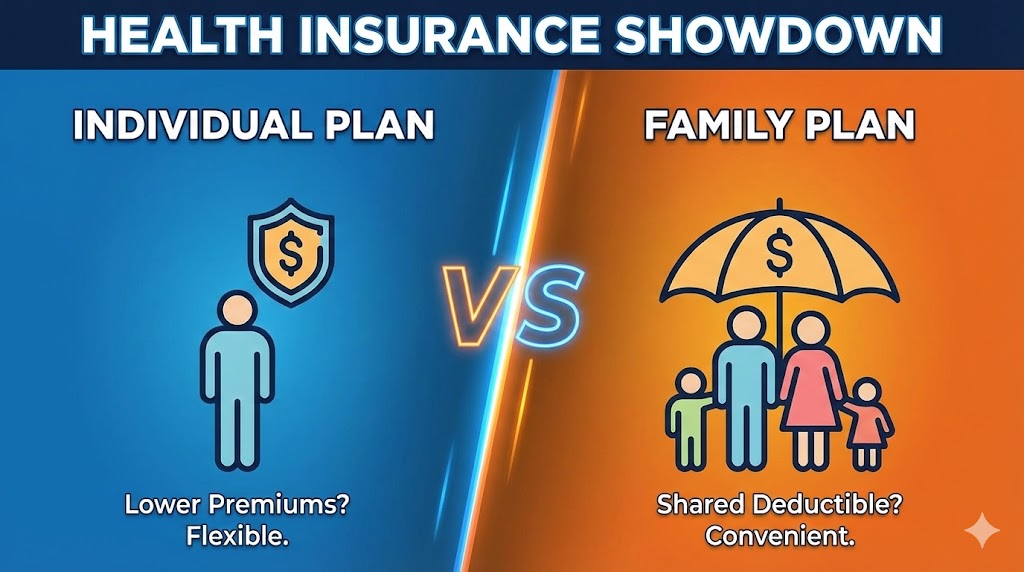
Individual Health Insurance
An individual health insurance plan is a policy purchased for just one person. It is not tied to a job or a spouse’s coverage.
- Coverage: dedicated solely to the policyholder.
- Deductible: You only have to meet your own individual deductible before the insurance company starts paying.
- Premiums: Based strictly on your age, location, and tobacco use (in the US).
Family Health Insurance
A family health plan covers the primary policyholder plus their spouse and/or dependent children.
- Coverage: Shared among all members.
- Deductible: Typically includes both an individual deductible (for each person) and a “family aggregate deductible.” Once the family hits the aggregate number, coverage kicks in for everyone, regardless of whether individual members have met their personal caps.
- Premiums: Calculated based on the age of family members and the number of people covered.
Cost Analysis 2025: Breaking Down the Premiums
When you compare health insurance plans, the “sticker price” (premium) is often the first thing you see. However, the cheapest monthly payment doesn’t always equal the lowest total cost.
1. The Premium Gap
- Individual Plans: In 2025, the average annual premium for employer-sponsored individual coverage is approximately $9,325. On the ACA Marketplace (Obamacare), a benchmark Silver plan can cost between $450 and $600 per month before subsidies.
- Family Plans: Family premiums have risen sharply, averaging nearly $27,000 per year for employer-sponsored plans. Employees typically contribute about $6,850 of this out-of-pocket, with the employer covering the rest.
2. The Deductible Trap
This is where families often get confused.
- Scenario: A family plan has a $6,000 deductible.
- Reality: You might have to pay $6,000 in medical bills total across the family before the insurer pays a dime. In contrast, an individual plan might have a $1,500 deductible. If one person gets sick, they access benefits much faster on an individual plan than they would waiting for the whole family to hit the $6,000 threshold.
Pro Tip: Look for “embedded deductibles” in family plans. This ensures that if one family member hits their individual deductible (e.g., $1,500), the insurance pays for them even if the larger family deductible hasn’t been met.
Individual Health Plans: When to Go Solo
Buying separate policies for each family member might seem like a headache, but it can save thousands in specific scenarios.
Best For:
- Self-Employed & Freelancers: If you don’t have access to a group plan, buying individual plans on the Health Insurance Marketplace allows you to customize coverage. One healthy spouse might choose a cheap Bronze plan, while the spouse with a chronic condition buys a Gold or Platinum plan.
- Age Gaps: In some private markets, adding an older spouse to a policy can skyrocket the premium for everyone. Separate policies allow the younger person to pay a lower rate.
- Different Medical Needs: If one person needs expensive prescriptions and specialist visits (high utilization) but the rest of the family is healthy, isolating the high-user on a comprehensive plan while keeping the others on a high-deductible health plan (HDHP) can be cost-effective.
The “Subsidies” Factor
Under the Affordable Care Act (ACA), millions of Americans qualify for Advanced Premium Tax Credits that lower monthly bills. These subsidies are based on household income. Sometimes, splitting the family onto different plans can affect subsidy eligibility, so use a health insurance calculator carefully.
Family Health Plans: The Power of Bundling
For most households, a single family plan remains the standard choice, especially when offered through an employer.
Best For:
- Convenience: One bill, one renewal date, one insurance card. Managing three different policies with three different networks is a logistical nightmare.
- Employer Subsidies: Most employers subsidize a significant portion of the premium. Walking away from an employer-sponsored family plan to buy full-price individual plans is rarely financially wise.
- Large Families: In some private plans, after the first two or three children, additional children are covered at no extra cost or a significantly reduced rate.
- Shared Out-of-Pocket Maximum: If your family faces a catastrophic year (e.g., a car accident involving multiple members), a family plan caps your total liability. Once you hit the Out-of-Pocket Maximum, the insurer pays 100% for everyone.
Critical Features to Compare: HMO vs. PPO
Whether buying individual or family coverage, the type of network matters immensely for your access to care.
HMO (Health Maintenance Organization)
- Lower Premiums: Generally the most affordable health insurance option.
- Restriction: You must use doctors in the network. No coverage for out-of-network care except emergencies.
- Referrals: You need a referral from a primary care doctor to see a specialist.
- Verdict: Good for families on a budget who don’t travel often.
PPO (Preferred Provider Organization)
- Higher Premiums: Costs more than HMOs.
- Flexibility: You can see any doctor you want, though staying in-network is cheaper. No referrals needed.
- Verdict: Essential for those with complex health issues who need access to top specialists nationwide.
International Context: USA, UK, and Canada
While the core concepts remain similar, the “why” differs by country.
USA: The Necessity
In the US, health insurance is a shield against bankruptcy. The focus is on comprehensive major medical coverage that covers everything from doctor visits to surgery.
UK & Canada: The Supplement
In the UK and Canada, public healthcare (NHS and Medicare) covers the basics. However, millions purchase Private Medical Insurance (PMI).
- Why buy it? To skip long waiting lists for elective surgeries, get private hospital rooms, and access drugs not yet approved by the public system.
- Family vs. Individual: In the UK, family health insurance often comes with perks like “kids go free” or discounted gym memberships, making it highly competitive against individual PMI policies.
5 Steps to Choose the Best Plan in 2025
- Audit Your Health: List every doctor’s visit and prescription from last year. Did you spend $500 or $15,000?
- Check the Network: Ensure your preferred pediatrician and specialists are “in-network.” Out-of-network bills can bankrupt you even with insurance.
- Calculate “Total Risk”: Don’t just look at the premium. Add the Annual Premium + Maximum Out-of-Pocket. This is the worst-case scenario cost for the year.
- Investigate HSAs: If you choose a High Deductible Health Plan, can you open a Health Savings Account (HSA)? This allows you to pay for medical expenses with tax-free money.
- Review the Formulary: If anyone takes medication (like insulin or GLP-1 agonists), check the plan’s drug list (formulary) to see what “tier” the drug is in.
FAQ: Frequently Asked Questions
Can I buy a family plan if we aren’t married?
In most cases, yes. Domestic partners are eligible for many employer and private plans. However, you may need to provide proof of cohabitation or financial interdependence.
Is it cheaper to have two individual plans or one family plan?
If both spouses have access to employer-sponsored insurance, it is often cheaper for each to stay on their own employer’s plan rather than one adding the other. Employers often charge a surcharge for adding a spouse who has coverage available elsewhere.
Can I switch from an individual to a family plan mid-year?
Only if you have a Qualifying Life Event (QLE). Examples include getting married, having a baby, adopting a child, or losing other health coverage. Otherwise, you must wait for the Open Enrollment Period.
What is the “Family Glitch”?
Historically, if an employee’s individual insurance was affordable, the whole family was disqualified from ACA subsidies, even if the family plan was unaffordable. This was fixed in 2023. Now, if the family premium costs more than roughly 8.39% of household income, the family may qualify for marketplace subsidies.
Do short-term health insurance plans cover families?
Yes, short-term health insurance is available for families, often at a fraction of the cost of ACA plans. However, they are risky: they typically do not cover pre-existing conditions, maternity care, or mental health, and they are not a substitute for comprehensive coverage.
Conclusion: Securing Your Future
Choosing between individual and family health insurance is a balancing act between monthly budget and long-term security. In 2025, with costs higher than ever, the “set it and forget it” approach is costing Americans billions.
Take the time to run the numbers. If your family is young and healthy, a high-deductible family plan with an HSA might build wealth. If you have diverse medical needs, splitting into individual policies might provide better care for less money.
Ready to find the right coverage? Start by requesting health insurance quotes from multiple providers today to see the real-world difference in premiums for your specific zip code. Your health—and your wallet—will thank you.